
No products
Prices are tax included
Seawater Food
- Basins
- Air Liquide
- Aquarium Hobby
- Dogs
- Cats
- Birds

Viewed products
-

Easy reefs DKI marine...
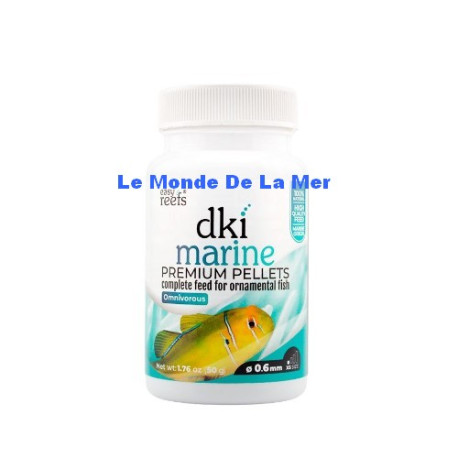
DKI Marine is a complete feed that...
-

Ro Cartridge...
1/4 inch quick connector to connect...
 View larger
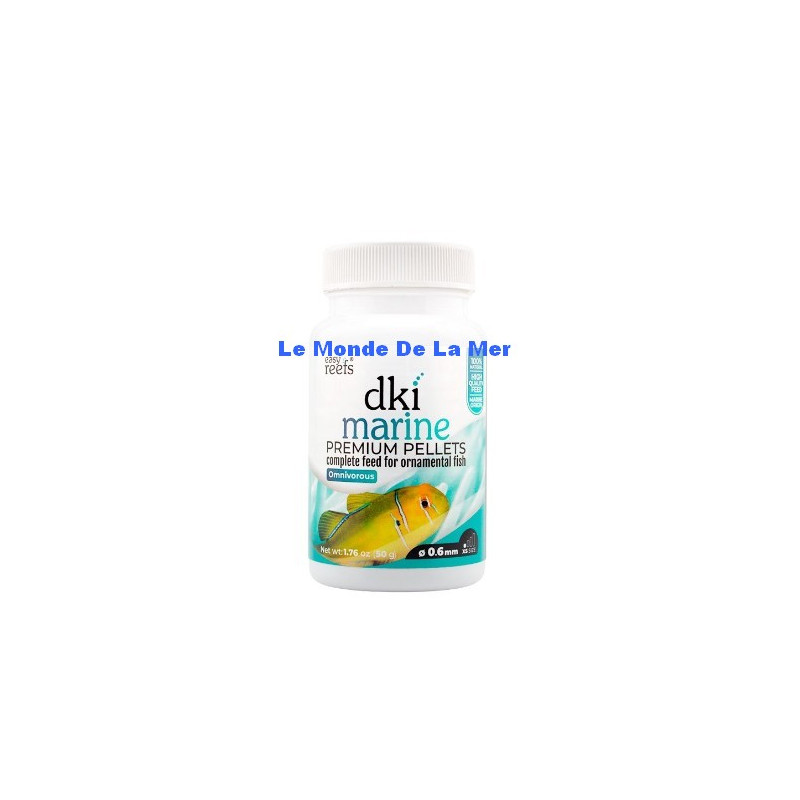
Easy reefs DKI marine Ø 0.8 mm 70gr - Le Monde De La Mer
DKI08.70
New product
DKI Marine is a complete feed that has been developed to meet the nutritional needs of omnivorous marine fish in coral reef biotopes.
25 Items
No reward points for this product.
More info
DKI Marine is presented in the form of sticky pellets with neutral buoyancy. It is available in granulometries of Ø 0.8 mm, Ø 1.2 mm, and Ø 2 mm.
DKI Marine is primarily composed of freeze-dried shrimp meal (Palaemonetes varians).
The microalgae (Nannochloropsis, Tetraselmis, Isochrysis, and Phaeodactylum) included in its formulation provide fatty acids, fully natural vitamins, functional compounds, and bioactive ingredients that preserve and enhance the general well-being of marine fish.
The morphological and organoleptic characteristics of the product, combined with high biological value proteins due to their composition in essential amino acids and their proportion, the composition of its fatty acids, and the fully bioavailable micronutrients involved in the metabolic pathways of fish, make DKI Marine pellets a feeding system based on a holistic concept of coral reef marine fish nutrition.
Storage: Store DKI Marine in a dark, dry, and cool place. The storage temperature should not exceed 25°C. In summer, if temperatures are higher, it is recommended to store it in a climate-controlled room.
Aquatic invertebrates (Palaemonetes varians), microalgae (Nannochloropsis, Isochrysis, Tetraselmis, Phaeodactylum), and macroalgae (Ulva, Chondrus).
Feed two or three times a day with amounts that can be consumed within two minutes of administration.
Add the pellets directly to the aquarium, manually or using an automatic dispenser. The pellets can be pre-moistened with aquarium water to speed up their sinking, making it easier for benthic fish to feed.
Tetraselmis chuii:
- Due to its high content of antioxidants Superoxide Dismutase, Catalase, and Glutathione Peroxidase.
- Highly digestible for filter feeders and zooplankton.
- Provides a high content of polysaccharides, polyunsaturated fatty acids (PUFA), pigments, and other lipid compounds.
Phaeodactylum tricornutum:
- Due to its high content of beta-glucans that improve the immune system of fish, making them more resistant to parasites and diseases.
- Content of proteins, carbohydrates, and lipids, rich in antioxidants and carotenoids such as fucoxanthin, which helps process fat and prevents its accumulation via tissue.
- Increases the oxidation of fatty acids and decreases the content of liver lipids (fatty livers), which is common in fish.
- High content of EPA and DHA.
Nannochloropsis gaditana:
- Provides a lipid profile rich in EPA and ARA.
- High content of high-quality Omega-3 fatty acids (EPA).
- Source of vitamins and natural antioxidants.
Isochrysis galbana:
- High content of fats rich in essential polyunsaturated fatty acids (omega-3), primarily DHA.
- High protein content.
- Source of natural pigments such as lutein, zeaxanthin, astaxanthin, etc.