
No products
Prices are tax included
Artemias and hatchers
- Basins
- Air Liquide
- Aquarium Hobby
- Dogs
- Cats
- Birds

Viewed products
-

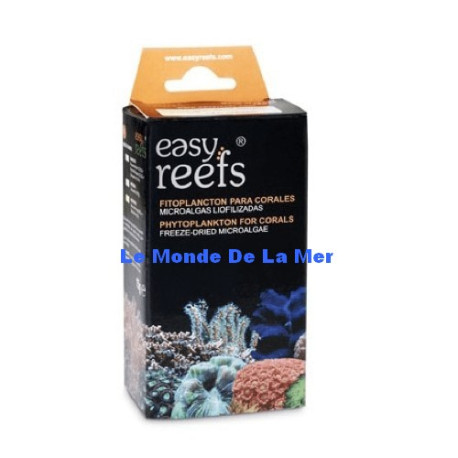
Easy reefs Corales...
Easy Reefs® Rotifer has been...
 View larger
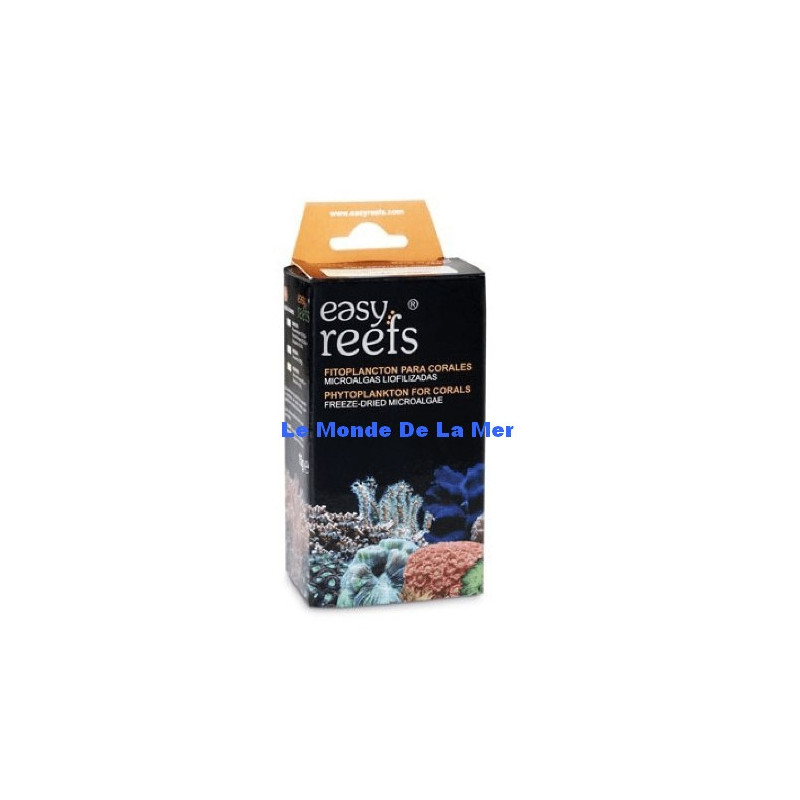
Easy reefs Corales 15gr - Le Monde De La Mer
ER03
New product
Easy Reefs® Rotifer has been developed for the cultivation of rotifers.
8 Items
By buying this product you can collect up to 1 loyalty point. Your cart will total 1 loyalty point that can be converted into a voucher of 0,10 €.
More info
Phytoplankton, or marine microalgae, are microscopic plant cells found dispersed throughout the sea. Phytoplankton forms the base of the food chain in aquatic ecosystems, serving as food for larger organisms, such as zooplankton. Marine phytoplankton is a very complete food source, containing vitamins, essential fatty acids, amino acids, carbohydrates, and proteins necessary for the development of various aquarium organisms. Easy Reefs® is 100% freeze-dried marine phytoplankton, providing all the benefits of microalgae in an easy-to-use format. With Easy Reefs®, you can achieve excellent results in your marine aquarium. Nutritional characteristics of Easy Reefs® Easy Reefs® freeze-dried microalgae retain the same nutritional properties as those found alive in the marine environment. The nutritional profile of the different Easy Reefs® species is detailed below:
|
Species |
Lipids |
Fatty Acids |
Amino Acids |
Vitamins |
Carbohydrates |
Proteins |
|
Nannochloropsis gaditana |
20 % |
EPA ARA, DHA, GLA
|
Isoleucine, Leucine, Lysine, Methionine, Phenylalanine, Proline, Threonine, Tryptophan, Valine, Alanine, Arginine, Aspartic Acid, Glutamic Acid, Glycine, Histidine, Tyrosine |
Folic Acid, Vitamin A, Vitamin B1 (thiamine), Vitamin B2 (riboflavin), Vitamin B3 (niacin), Vitamin B5 (pantothenate), Vitamin B6 (pyridoxine), Vitamin B12 (cobalamin), Vitamin E (tocopherol), Vitamin C (vitamin B12). Ascorbic Acid |
16 % |
39 % |
|
Tetraselmis chuii |
17 % |
EPA ARA, |
20 % |
41 % |
||
|
Phaeodactylum tricornutum |
22 % |
EPA |
30 % |
33 % |
Storage. Store Easy Reefs® Rotifers in a dark, dry, and cool place. The storage temperature should not exceed 25°C. In summer, if temperatures are higher, it is recommended to store it in a climate-controlled room. Once the container is opened, it is very important to keep the biomass dry and in the dark. Avoid storing it in places with high humidity (condensation upon opening the jar causes the microalgae to absorb moisture and degrade). Keep the container tightly closed. Once opened, use preferably within 4 months.
Two species of Easy reefs® microalgae (Nannochloropsis 80% + Tetraselmis 20%) are used to ensure proper rotifer growth.
The average consumption is 100 mg per liter of rotifer culture per day, harvesting 25% of the rotifers daily, although the dosage depends on the rotifer density achieved.
To maintain a rotifer culture, follow these instructions:
Materials needed: Three 2-liter cylindrical containers with gentle aeration using a hollow rod. Initial rotifer inoculum.
Food needed: Easy Reefs® Rotifer: Nannochloropsis (80%) + Tetraselmis (20%).
Culture cycle from starter culture: 5 days
Recommended water density: 1.019, although it can be successfully cultured up to 1.024.
Optimal rotifer culture temperature: 22°C to 25°C
This system uses parallel culture, providing a continuous supply of food for the aquarium starting on day 6. One container is used for starter culture, and another for production.
The algae should be resuspended using a blender, following the resuspension instructions, with a volume of 0.5 L of seawater.
The dosage data detailed below are under ideal conditions, assuming the ideal rotifer density. Occasionally, the amount of algae added may not meet the rotifer's needs. If the water becomes clear, it indicates that the dose was insufficient. When rotifers are without food for more than 4 hours, the number of eggs decreases, and therefore, so does the population growth rate. It is essential that the rotifers always have food available.
Rotifers are very sensitive to changes in the water's physicochemical parameters. If the water quality deteriorates rapidly, the rotifer population will be affected. If excessive dirt is observed in the tube, filter the rotifers and inoculate them into a clean tube, then add the necessary algae.
With experience, the intensity of the green color will indicate the amount of algae needed; you could even develop your own feeding protocol. There is no difference between live and freeze-dried algae for use as food; however, freeze-dried microalgae are dead and have a shorter decomposition period, so you must be careful with water quality.
A 5 mm diameter rod is inserted into the culture tube with very gentle aeration (about 5-10 bubbles per second) to ensure a homogeneous mixture of the culture. Excessive turbulence causes the rotifers to lose their eggs, preventing them from hatching.
It is recommended to divide the feeding dose into two or more feedings per day, but due to time constraints, rotifers are usually fed once a day.
DAY 1
Initial conditions: "Strain" culture with 1000 ml of seawater, rotifer count of 400 rot/ml to 600 rot/ml, and 100 mg of Easy Reefs® Rotifer Nannochloropsis (80%) + Tetraselmis (20%).
Instructions: Resuspend 100 mg of Easy Reefs® Rotifer in 0.5 L of seawater (according to the instructions) and add it to the container. Add the rotifer inoculum and fill to the mark with seawater up to 1 L.
DAY 2
Initial conditions: 1 L of rotifer culture. It will be almost clear and almost algae-free. Estimated rotifer count: 500 rot/ml.
Final conditions: The culture will have a final volume of 1.4 L with algae.
Instructions: Resuspend 100 mg Easy Reefs® Rotifer in 0.5 L of seawater and add 0.4 L to the rotifer culture.
DAY 3
Initial conditions: 1.4 L of rotifer culture. It will be almost clear and almost algae-free. Estimated rotifer count: 500-600 rot./ml
Final conditions: The culture will have a final volume of 1.8 L with algae.
Instructions: Resuspend 200 mg Easy Reefs® Rotifer in 0.5 L of seawater and add 0.4 L to the rotifer culture.
DAY 4
Initial conditions: 1.8 L of rotifer culture. It will be almost clear and almost algae-free. Estimated rotifer count: 600 rot./ml
Final conditions: The culture will have a final volume of 2 L with algae.
Instructions: Resuspend 300 mg Easy Reefs® Rotifer in 0.5 L of seawater and add 0.2 L to the rotifer culture.
DAY 5
Initial conditions: 2 L of rotifer culture. It will be almost clear and almost algae-free. Estimated rotifer count: 700-800 rot./ml
From this "strain" culture, take a partial harvest of 0.5 L to start a new "strain" culture in another 2 L container and begin a new cycle as on Day 1.
To the old "strain" culture, which will now be the "production" culture, add Easy Reefs® Rotifer and bring the volume up to 2 L. If the container is too dirty, transfer it to a clean one to continue the production culture.
Instructions: To the "production" culture, add 200 mg of Easy Reefs® Rotifer previously resuspended in 0.5 L of seawater. In the "strain" culture, start a new cycle from day 1.
DAY 6
Initial conditions: "Strain" culture as on day 2. The "production" culture (2 L with 800 rot/ml) will be almost clear and almost algae-free.
The "production" culture will be used to harvest 0.5 L daily for...
Resuspension Instructions
Easy Reefs® are freeze-dried marine microalgae and must be rehydrated before use. For proper rehydration, follow these steps:
Place the indicated amount of seawater in the blender.
Add the indicated amount of Easy Reefs®.
Let the Easy Reefs® microalgae rehydrate for one minute without shaking.
Blend on the lowest speed for one minute.
Add to the aquarium as directed.
One level scoop = 100 mg of Easy Reefs® microalgae.
Only prepare what you will use. It is not recommended to store any leftover product after resuspension. Even in the refrigerator, nutritional properties are lost due to oxidation.