
No products
Prices are tax included
Artemias and hatchers
- Basins
- Air Liquide
- Aquarium Hobby
- Dogs
- Cats
- Birds

Viewed products
-

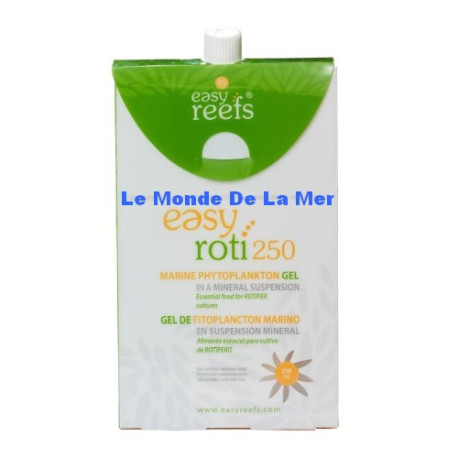
Easy reefs Easyroti...
Easyroti is liquid marine...
 View larger
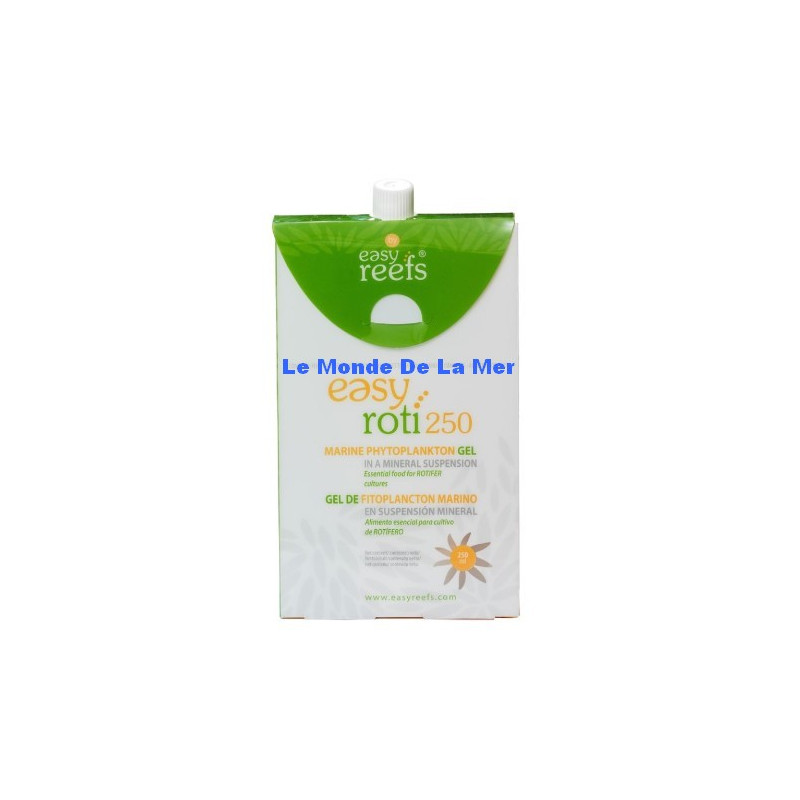
Easy reefs Easyroti 250ml - Le Monde De La Mer
ERO250
New product
Easyroti is liquid marine phytoplankton, specifically formulated for rotifer cultivation.
10 Items
By buying this product you can collect up to 1 loyalty point. Your cart will total 1 loyalty point that can be converted into a voucher of 0,10 €.
More info
We use two species of Easy Reefs® microalgae for rotifer cultivation: Nannochloropsis (80%) and Tetraselmis (20%).
Storage: Store Easyroti in a dark, dry, and cool place. The storage temperature should not exceed 25°C. In summer, if temperatures are higher, it is recommended to store it in a climate-controlled room.
Once opened, the expiration date does not change, even if use has begun. The reason the expiration date does not change is that the bag compresses as the gel is dispensed. This prevents air from entering the bag and therefore prevents phytoplankton oxidation.
Nannochloropsis (80%) + Tetraselmis (20%).
Cell concentration: 5 x 10⁹ cells/ml
It is recommended to distribute the Easyroti dosage throughout the day.
For proper dispersion, Easyroti must be introduced into the culture tank after being diluted in the culture water.
Easyroti can be added automatically using a dosing pump, provided that proper dispersion of the product is ensured.
To maintain a rotifer culture, follow these instructions:
Materials needed: Three 2-liter cylindrical containers with gentle aeration via a hollow rod. Initial rotifer inoculum.
Food required: Easyroti: Nannochloropsis (80%) + Tetraselmis (20%).
Culture cycle from starter culture: 5 days.
We will refer to "seawater" as water prepared with marine aquarium salts at a specific gravity of 1019-1022.
The culture temperature should be maintained between 20-28°C, with 24°C being optimal.
A 50-micron mesh filter is required to filter the rotifers.
This system consists of a parallel culture where, starting on day 6, a continuous supply of food is obtained for the aquarium. There is one container for "Strain" and another for "Production."
The dosage data detailed below are based on ideal conditions, assuming the ideal rotifer density. Occasionally, the amount of algae added may not meet the rotifer's needs. If the microalgae are depleted (the water becomes clear and yellowish), it indicates that the dosage was insufficient. When rotifers go without food for more than 4 hours, the number of eggs decreases, and therefore, so does the population growth rate. It is essential that the rotifers always have food available.
Rotifers are very sensitive to changes in the water's physicochemical parameters. If the water quality deteriorates rapidly, the rotifer population will be affected. If excessive dirt is observed in the tube, filter the rotifers and inoculate them into a clean container, adding the necessary algae.
With experience, the intensity of the green color will indicate the amount of algae needed; you could even develop your own feeding protocol. There is no difference between using live algae or Easyroti as food.
A 5 mm diameter rod is inserted into the culture tube with very gentle aeration (5-10 bubbles per second) to ensure a homogeneous mixture of the culture. Excessive turbulence causes the rotifers to lose their eggs, preventing them from hatching.
It is recommended to distribute the feeding dose in two or more feedings per day, but due to time constraints, rotifers are usually fed once a day.
DAY 1
Initial conditions: "Strain" culture with 500 ml of seawater.
Number of rotifers: 400 rot./ml to 600 rot./ml and 4 ml of Easyroti Nannochloropsis (80%) + Tetraselmis (20%).
Final conditions: The culture will have a final volume of 1 L with algae.
Instructions: Disperse 4 ml of Easyroti in 0.5 L of seawater. Add the rotifer inoculum.
DAY 2
Initial conditions: 1 L of rotifer culture. It will be almost clear and almost algae-free.
Estimated rotifer count: 500 rot./ml
Final conditions: The culture will have a final volume of 1.4 L with algae.
Instructions: Disperse 4 ml of Easyroti in 0.5 L of seawater and add 0.4 L to the rotifer culture.
DAY 3
Initial conditions: 1.4 L of rotifer culture. It will be almost clear and almost algae-free.
Estimated rotifer count: 500-600 rot./ml
Final conditions: The culture will have a final volume of 1.8 L with algae.
Instructions: Disperse 8 ml of Easyroti in 0.5 L of seawater and add 0.4 L to the rotifer culture.
DAY 4
Initial conditions: 1.8 L of rotifer culture. It will be almost clear and almost algae-free.
Estimated rotifer count: 600 rot./ml.
Final conditions: The culture will have a final volume of 2 L with algae.
Instructions: Disperse 6 ml of Easyroti in 0.25 L of seawater and add 0.2 L to the rotifer culture.
DAY 5
Initial conditions: 2 L of rotifer culture. It will be almost clear and almost algae-free.
Estimated rotifer count: 700-800 rot./ml.
From this "strain" culture, a partial harvest of 0.5 L is taken to start a new "strain" culture in another